7 Questions to Ask Your Architect Before You Sign
By Cody Johnston, PE, MBA · · 5 min read
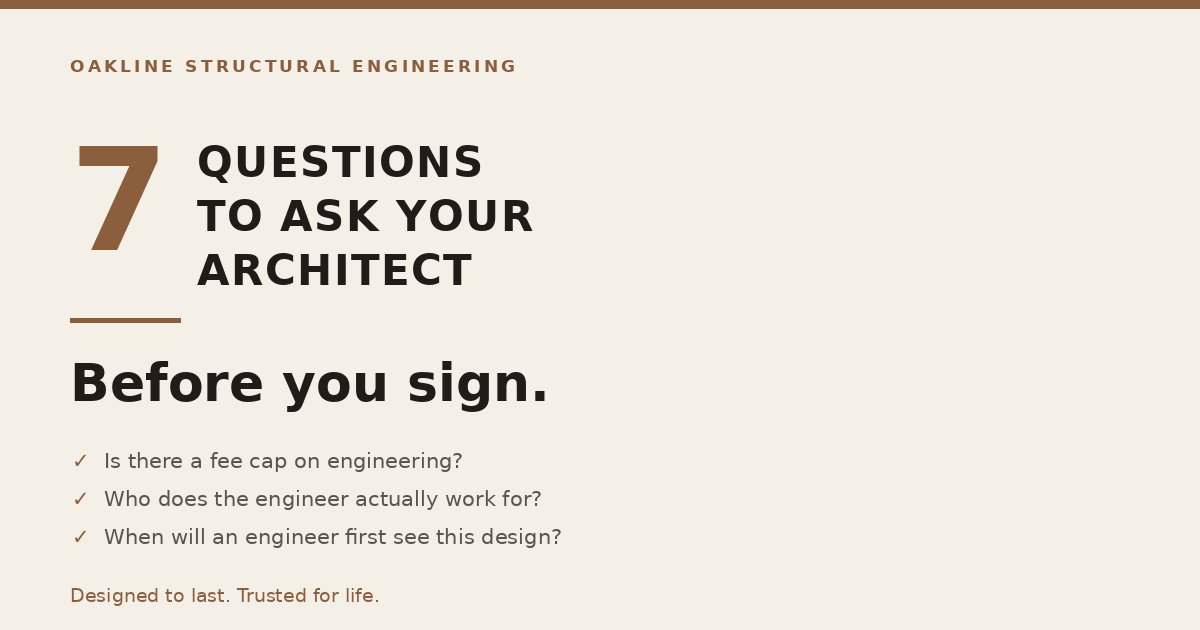
Seven questions, about ten minutes, and potentially tens of thousands of dollars.
Hiring an architect is one of the most exciting parts of building a custom home. It’s also the moment where most of your construction budget quietly gets decided — long before a single board is bought.
Most owners review an architect’s contract for scope, schedule, and fee. Those matter. But the questions below are the ones almost nobody asks, and they’re the ones that move real money.
You don’t need to be an engineer to ask them. You just need to ask them before you sign, while you still have leverage.
(For the story that prompted this list — a $7,000 line in a contract that cost an owner about $50,000 — read: The $7,000 Cap That Cost $50,000.)
1. “Is there a fee cap or a not-to-exceed number for engineering in this contract?”
Why it matters: Very often, yes — and it’s usually presented as a benefit to you.
What you’re listening for: Any language like “engineering not to exceed $X” or “engineering allowance of $X.”
What to do with the answer: Don’t necessarily strike it. Just understand it for what it is: a limit on how much thinking gets applied to your structure. Then ask question 2.
2. “What happens if the design ends up needing more engineering than that number?”
Why it matters: This is the whole ballgame. There are only two possible answers, and they cost wildly different amounts.
What you’re listening for:
- Good answer: “We come back to you, explain why, and you decide.”
- Expensive answer: “The engineer works within the budget.”
That second answer sounds responsible. It isn’t. An engineer working to a hard fee cap doesn’t do worse work — he does faster work, and fast structural design means oversized members, more steel, more concrete, and a bigger construction bill. The savings never show up as a savings. They show up as material.
What to do with the answer: Ask for language that says the engineering budget can be revisited with your approval if the design requires it. You are not agreeing to spend more. You are simply protecting your right to be told.
3. “When will a structural engineer first look at this design?”
Why it matters: Structural engineering is worth the most before the drawings are finished and almost nothing after.
Early, an engineer can say “move that wall eighteen inches and this whole floor frames in wood.” Late, the only lever left is buying more expensive material.
What you’re listening for: “At schematic design” or “once we have a preliminary floor plan.”
Red flag: “Once the drawings are complete” or “at permit.” By then, your budget has already been spent — on paper.
What to do with the answer: Ask for a structural review at schematic design. It’s a few hours of a PE’s time and it’s the cheapest money in the entire project.
4. “Who does the structural engineer work for — you or me?”
Why it matters: In most projects the engineer is a subconsultant to the architect. That means the engineer’s client is the architect, not you.
That works fine, almost all the time. It stops working in the exact moment it matters most: when saving you money would require the architect to revisit something he’s already committed to.
What you’re listening for: Honesty. Most architects will say “the engineer works under us,” and that’s a normal, fine answer.
What to do with the answer: Ask whether the architect is comfortable with you retaining the structural engineer directly, in parallel. Good architects generally are. It costs you almost nothing and it puts one person on the project whose only job is looking out for your budget and your building.
5. “Are there elements of this design that are non-conventional — and do you know what they’ll cost to build?”
Why it matters: Long spans, big openings, cantilevers, floating stairs, walls of glass, rooms without the walls underneath them — these are usually the best parts of a custom home and the most expensive parts of the structure. They’re worth having. They’re just worth having knowingly.
What you’re listening for: A specific, direct answer. “The great room span will probably need engineered beams or steel — we should price that.”
Red flag: “The engineer will figure it out.” That’s not an answer, that’s a handoff — and a handoff is where cost hides.
What to do with the answer: For every non-conventional element, ask what the conventional alternative would look like and what it would save. Then decide. Some of them will be worth every penny. Some of them you’ll happily trade away once you see the number.
6. “What’s the plan if the builder’s bid comes in over budget?”
Why it matters: This is the moment of truth on every custom home, and if the answer is “we’ll value-engineer it later,” you should know that later is the worst and most expensive time to do it.
Redesigning a structure after the drawings are complete means paying twice — once for the original set, once to fix it — and you’ll usually end up trimming finishes you actually wanted instead of structure you never needed.
What you’re listening for: A design process that checks cost along the way, not at the end.
What to do with the answer: Ask for a rough structural cost check before the drawings are finalized. It’s not a formal estimate. It’s an engineer looking at the plan and telling you where the money is.
7. “Can I have your engineer’s number?”
Why it matters: This is the simplest question on the list and it tells you an enormous amount.
What you’re listening for: “Sure.”
If the answer is anything other than a comfortable yes, that’s worth noticing. There is no good reason you shouldn’t be able to talk directly to the licensed professional who is designing the thing holding your house up.
What to do with the answer: Call them. Ask them what they think of the design. Engineers are famously blunt. You will learn a great deal in fifteen minutes.
The one-sentence version
You are allowed to ask how much thinking is going into your house, who that thinking is being done for, and when.
Ask early. Ask directly. Ask before the drawings are finished — because that’s the last moment when the answers are still free.
A note on architects
None of this is an argument against architects. A good architect is worth every dollar, and the best custom homes on earth exist because someone with real vision drew them.
This is an argument against a structure of contracts that quietly puts your architect and your budget on opposite sides of a question — and then never tells you the question was asked.
Your architect isn’t your adversary. But on the day when saving you $50,000 requires an uncomfortable conversation, you want somebody in the room whose job it is to have it.
Cody Johnston, PE — Oakline Structural Engineering, Raleigh, NC. We do structural design and structural review for custom homes, additions, and renovations across North Carolina. If you’re in the design phase and want an engineer looking at the plan while it can still change, get in touch.
Designed to last. Trusted for life.