The $7,000 Engineering Cap That Cost $50,000
By Cody Johnston, PE, MBA · · 7 min read
Why the line in your contract that looks like cost control is quietly the most wasteful line in the project.
A homeowner hired an architect to design a custom home. Good architect. Real drawings. A house the owner loved.
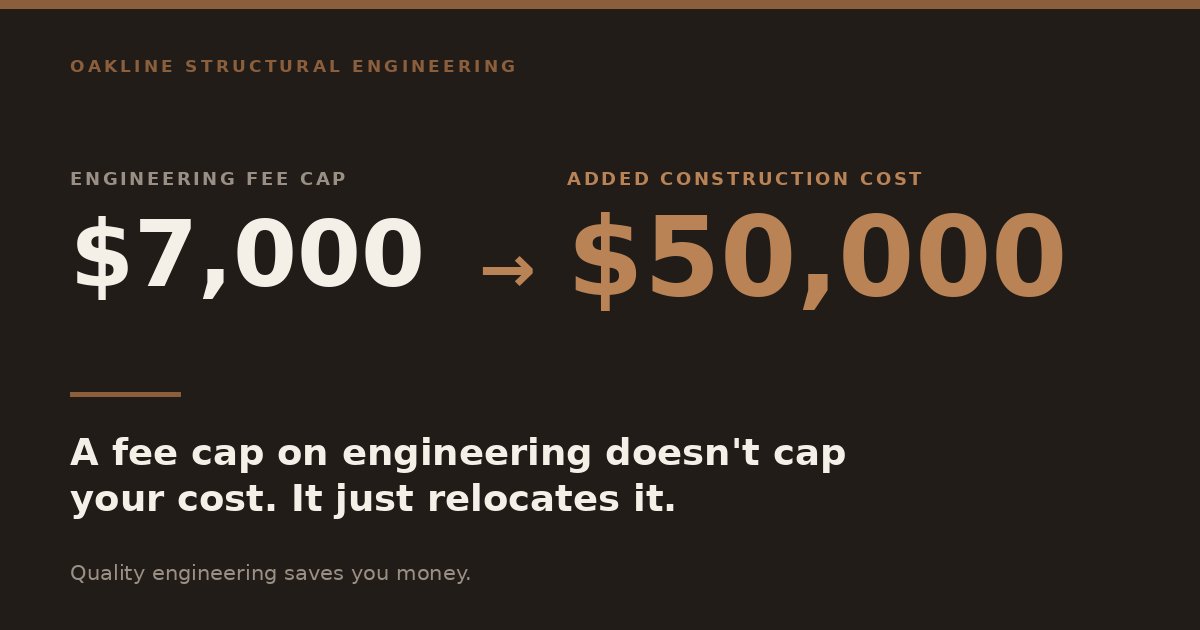
Buried in that architect’s contract was a line that looked like it was protecting the owner: engineering not to exceed $7,000.
That line cost him roughly fifty thousand dollars. He will almost certainly never find out.
Here’s what happened.
What the drawings actually asked for
When the architectural set came to us for structural engineering, the design was not conventional. Long spans. Big openings. Cantilevers. Loads landing in places where, in a normal house, there would be a wall.
None of that is a criticism. That’s often exactly what makes a custom home worth building. But it does mean the structure has to be solved, not looked up.
There were two ways to solve it.
Path A — the fast one. Reach for steel and other commercial materials. Steel does not care about long spans; it eats them. It is fast to specify, fast to check, and completely defensible. This path fits comfortably inside a $7,000 engineering fee.
It also adds somewhere in the neighborhood of $50,000 to the cost of construction. Steel is expensive to buy, expensive to ship, expensive to erect, and it drags along fabricators, cranes, and connection details that a residential framing crew is not set up for.
Path B — the real engineering. Spend more engineering hours. Push back on a handful of things in the architectural that were driving the worst of the loads. Design custom, engineered detailing in wood — assemblies that are not in any prescriptive code table because they have to be calculated from scratch — and get the structure to work in materials a framing crew already knows how to build.
Path B costs more to engineer. Maybe a few thousand dollars more. And it saves tens of thousands during construction.
And here is the part that matters: Path B was not going to slow the project down. I quoted a two-week turnaround on it. Same delivery date. Nobody’s schedule moved.
That’s worth saying clearly, because “we don’t have time for that” is the reflex, and in this case it simply wasn’t true. The only thing standing between that owner and a $50,000 savings was a $6,500 additional line item — and a conversation nobody wanted to have.
The conversation
I brought this to the architect. He didn’t argue. He understood the problem completely — better than most, honestly. He agreed the design had non-conventional elements. He agreed most engineers, handed a $7,000 cap, would simply take Path A, spec the steel, stay inside the fee, and never mention that Path B existed.
Then he asked me to just use the steel.
Not because he’s a bad architect. Because going back to the owner and saying “the engineering budget I put in our contract isn’t enough for the house I designed” is an uncomfortable conversation. It sounds like an admission. It reopens a number that was already agreed to. It’s easier to let the extra cost land somewhere else.
And that’s the part I want you to sit with, because it isn’t really about one architect. He was boxed in by a structure he didn’t design and probably didn’t think hard about when he wrote it. Almost every architect writes that line. Most owners ask for that line.
Nobody was going to build an unsafe house
Let me be very clear about something, because this is where people expect the scary part.
The steel house is not dangerous. It is not under-engineered. It is safe, code-compliant, and will stand for a hundred years.
It just costs $50,000 more than it needed to.
That’s the whole story. This is not a safety failure. It’s a money failure — and money failures are much harder to see, because nothing ever goes wrong. The house (if it gets built) works. The owner just paid for a structure he never needed. He could have put that money into other things. Remember, Quality Engineering Saves Money.
The mechanic nobody explains to owners
Here is the thing that took me years in this business to be able to say out loud in one sentence:
The lowest engineering fee often costs you the most.
That’s not a sales line. It’s mechanics.
Engineering hours are what take material out of a building. Every hour an engineer spends optimizing is an hour spent finding a way to carry the same load with less steel, less concrete, less lumber, fewer specialty connections, fewer trades.
Structural engineering is typically around 1%-2% of a project’s total cost. It dictates something closer to 30%–40% of it — the foundation, the framing, the load path, every structural member in the building. Capping the 1% to save two or three thousand dollars, while it swings the 40%, is one of the worst deals you can make.
A cap doesn’t cap cost. It relocates it.
This is the part I’d tattoo on a contract if I could.
The $7,000 ceiling did not save that owner money. It moved money.
It moved it off a line the owner watches closely — design fees, the line he negotiates, the line he compares between firms — and onto a line he doesn’t scrutinize at all: materials and labor. When the builder’s number comes back high, the owner will assume that’s just what building costs right now. He’ll blame lumber prices. He’ll blame the market. He’ll blame interest rates.
He will never blame a $7,000 cap, because the $7,000 cap is the one number in the project that came in exactly on budget.
That’s cost transfer, dressed up as cost control.
Engineering value is front-loaded, so engage with an engineer early
There’s a timing piece to this that owners almost never hear.
Early — while the plan is still fluid, before the architectural set is finished — a structural engineer has enormous leverage. He can say “shift that wall eighteen inches and the entire second floor frames in wood.” “Drop that beam six inches into the floor system and you don’t need a steel transfer.” “If that opening is nine feet instead of eleven, this whole wall changes.” These are small architectural adjustments with enormous cost consequences, and they’re free to make while the drawings are still moving.
Late — after the set is done, after the owner has fallen in love with the renderings, after everything is coordinated — the engineer has one lever left: buy more expensive material.
By the time most owners meet their structural engineer, the majority of their construction budget has already been spent on paper. The engineer isn’t shaping the cost of the house at that point. He’s just tallying it up.
So what do you actually do about it?
Three things, in order of how much they’ll save you.
1. Bring an engineer in before the architectural drawings are finished. Not after. The cheapest structural work you will ever buy is a few hours of a PE’s time while the floor plan can still move. Ask your architect to loop in the engineer at schematic design. It is a normal request. Good architects welcome it — the good ones already know their design has to stand up, and they’d rather find out now than at permit.
2. Consider retaining the structural engineer directly, not as a subconsultant. This is the quiet one, and it’s the real fix. When the engineer is hired by the architect, the engineer’s client is the architect. That works fine — right up until the moment those two interests split, which is exactly what happened in this story. When you hire the engineer yourself, the person who is going to tell you “there’s a cheaper way to build this” answers to the person whose money it is. That is a very different relationship, and it costs you almost nothing to set up.
3. Ask better questions before you sign anything. Most of this is preventable with about six questions asked at the right moment. I wrote them all down:
→ Questions to Ask Your Architect Before You Sign
The bottom line
A fee cap on engineering feels like you’re being a careful steward of your own money. It reads like protection. It’s the kind of thing a good, prudent owner puts in a contract.
But you cannot cap the cost of a building by capping the amount of thinking that goes into it. You can only decide where the cost shows up.
Pay a little more for the thinking. Pay a lot less for the building.
Quality engineering doesn’t cost you money. It saves you money.
Cody Johnston, PE — Oakline Structural Engineering, Raleigh, NC. We work directly for homeowners on custom homes, additions, and renovations across North Carolina — often alongside your architect, always in your corner. If you’re about to build and you want a second set of eyes on the structure before the drawings are locked, get in touch.
Designed to last. Trusted for life.